
|
|
The Zen of Filmmaking: A Balance of Heart
& Mind
by Xuan Vu © 2006
Chapter VI: The Post-Production Phase
:: Issues in Stylistic
Approach
:: Chronique d’un ete
:: To Live with Herds
:: Application of the Son Balance
:: One Precept: Zen Buddhism in America
:: MacDougalls’ Doon School Chronicles
:: The Koan: The Limits of Words
:: Letting Go of Concepts and Control
After four months
of filming and preliminary editing, it was time to consolidate all of
my accumulated knowledge on Zen and filmmaking into a final product for
this thesis project. By viewing films by the aforementioned leading figures
in visual anthropology, as well as another ethnographic film on American
Zen Buddhism, with a critical eye towards successful and unsuccessful
approaches, I decided to employ the methods that would be most effective
in conveying the story that emerged from my relationship with my subjects.
Issues in Stylistic Approach
As previously noted, one major area of disagreement that Josh and I had
concerned the film’s style and approach. In the beginning, I still
had my bias of what an educational film should be like, which resembled
a typical PBS documentary, with its sit-down interviews and complementary
b-roll captured afterwards. This was due to my training and background
in television, which had not been completely eradicated yet. Josh introduced
me to the idea of filming only process footage first and then, afterwards,
asking the subjects questions that were not fully addressed or answered
during the the time of filming. At first I was very enthusiastic about
this idea because it was an approach that broke from the tradition of
the “talking heads” and “the arrogance and intellectual
poverty of the traditional educational film or the sterility of much research
footage.”(1) In addition,
according to MacDougall, “[a]t the level of narrative, action becomes
the determining feature of character, since it is what the characters
do…that fixes them in dramatic constellations.”(2)
However, the more process footage we worked with, and the more information
about the center and the subjects’ personal stories were being cut
out, the less confident I became in this approach. Josh did not want to
rely on the subjects’ words to tell the story, but I began to feel
as though we should include the information necessary for establishing
context for the viewer. There was an inherent “danger” in
simply allowing the visuals to carry the weight of the story: it was “too
open to misinterpretation [and] too seductive.”(3)
MacDougall points out that it is the role of “the filmmaker to control
any potential misinterpretations of the material—not upon the viewer
to be a better interpreter of it.”(4)
Therefore, anything left ambiguous or vague should be clarified by the
filmmaker, either through the use of narration or information given by
the subjects. Josh figured that we would attend to these issues when we
finished editing the process footage, but I felt that we should be molding
the story according to what the subjects were telling us at the time.
Indeed, our issue represented a larger distinction between two approaches
that emerged after WWII: that between direct cinema and cinéma
vérité, which both fell under the style of observational
cinema.(5) Though both “were
movements opposed to formal methods of documentary filmmaking,”(6)
cinéma vérité was known for its emphasis on “a
certain kind of experience” while direct cinema emphasized information.(7)
In this sense, I could be said to have been a proponent of the latter
while Josh was of the former.
On the other hand, direct cinema emphasized the capturing of footage with
as little intervention from the filmmaker as possible while cinéma
vérité films showcased the interactions between filmmaker
and subjects, with the filmmaker asking the subjects questions to elicit
certain responses.(8) Though
not attempting to provoke certain reactions from my subjects, during the
filming of their activities I engaged the subjects in “conversation
[which] freed [the film] from the formality of the question-and-answer
format,”(9) probing them
for information about the Center and about themselves that I felt was
necessary for establishing context and their subjective experiences and
feelings. I wanted to include such information in my film, in much the
same way Rouch and MacDougall relied on interview footage from their subjects.
>>back to top
Chronique d’un ete (1961):
Rouch’s Chronique d’un ete is essentially a film centered
around his subjects’ interviews. In his inquiry about the level
of happiness in Paris, Rouch makes his subjects’ voices the dominant
element that occupies the film. Such emphasis makes a statement about
the issue of words versus experience in conveying reality. This emphasis
points directly to the aforementioned issue that Rouch is mainly concerned
with: namely, the problem that one cannot really capture real-life objectively
since it is based on the filmmaker’s discrimination of what to shoot
and what not to shoot and the manipulation of footage during the editing
process.(10) By letting his
subjects’ words dominate the film, Rouch implicitly calls attention
to the limits that their words can convey. This is a point most vital
to my film since the Zen tradition stresses the insignificance of words
and concepts. By giving weight to my subjects’ words, I am implicitly
trying to show the discrepancy between the Zen ideal and their Zen in
practice, underscoring the Americanization of this Eastern tradition.(11)
However, relying too much on words is not very effective either, as Rouch’s
film demonstrates when he includes a long sequence of a day in the life
of one of his subjects, Angelo. Grimshaw describes this sequence as a
“strange, muted, almost ghost-like interlude in a film dominated
by people talking. It brings powerfully to life what Angelo’s words
can only imperfectly suggest.”(12)
This segment of the film, in my opinion, was the most interesting and
engaging portion, in sharp contrast to the congested linguistic atmosphere
in the rest of the film. As MacDougall points out, “[f]ilmmakers
reach beyond the nameable and containable. It is the physical world underlying
signification that provides the motive power of [a film].”(13)
Also, reliance on words can be problematic: “[I]nterviews are perhaps
the ideal medium for confession and self-revelation, but also equally
for misinformation…representing limited perspectives and uneven
mixtures of candour and self-justification.”(14)
In essence, for a film to be both informative and authentic, it must seek
equilibrium between its visuals and its words.
>>back to top
To Live with Herds (1973):
The MacDougalls’ film, To Live with Herds(15)
, exemplifies the successful presentation of this delicate balance. In
this film, David and Judith MacDougall allow the subjects to speak for
themselves, using subtitles underneath their voices and minimal narration.
There are interviews and conversations with men, which establish the Jie’s
relations with the different tribes and reveal the benefits of having
the white man around to keep order among them. Due to Judith’s influence,
the women’s perspective is also addressed in an interview with a
woman about cattle raids and herding and in a conversation with another
woman who complains about her health. The MacDougalls’ seem to rely
on the subjects’ words for establishing information, their first-hand
experiences, and subjective feelings while using narration and intertitles
to provide the structure, argument and factual information of the film.
These testimonials and dialogs are effectively interwoven with the process
footage, such as that of the Jie washing their cows, children pumping
water into a ditch, and a man preparing to leave for cattle camp.
What characterizes the MacDougall project is a synthesis of both observational
approaches, direct and vérité. In fact, MacDougall thinks
of it as “beyond observational cinema,” since it combines
direct observation with a “more subdued and organized” version
of Rouch’s participatory style.(16)
He shows how “[e]thnographic understanding emerges from experience…as
much as from observation and intellectual reflection.”(17)
In the case of my film, I chose to make it in order to portray visually
my subjects’ experiences; otherwise, I might as well have simply
written about the case study for this project. Recognizing the success
that the MacDougalls’ film has in portraying the Jie culture and
people, I decided to employ such a balance between conversational interviews
and process footage.
>>back to top
Application of the Son Balance
Though there have been various fiction films made by Korean directors
about Buddhism, there has not yet been (to my knowledge) any ethnographic
documentaries made about Korean Son practice in the U.S. since the tradition
was only introduced to Americans 33 years ago. This puts my project in
a unique position, as it is the first representation of the Kwan Um School.
Therefore, it is critical that I produce an accurate and sensitive portrayal
of the CZC members’ lives, employing techniques that best convey
the emphasis placed on balance by the Chogye Order. To do so, I have critically
assessed and applied some methods from another ethnographic film.
>>back to top
One Precept: Zen Buddhism in America (1995):
One Precept: Zen Buddhism in America(18)
by Steve Flood and Robin Adams is a case study of a Japanese Rinzai-Ji
Zen temple in Los Angeles, CA. The film offers a detailed look at the
many aspects of practice in which the community participates, with a Zen
priest named Seiju explaining the principles of the practice throughout
the film.(19) The format
of this educational film, boasting a plethora of information through the
priests’ narrative voice, interview footage with other practitioners,
and process footage of the practice, was the initial approach for my own
film.
Though the film has much educational value and a poetic, mystical quality,
it falls short of being engaging or effective at conveying the actual
experiences of the practitioners. There is no particular storyline that
the film follows, only a vague structure that organizes the film into
segments about the practitioners’ religious backgrounds, general
historical background of Buddhism, explanation of the meaning of terms
and practices, contemplation about the meaning of Zen, and the assimilation
of Zen in America. These are all related through the subjects’ words,
which are overlaid onto footage of walking meditation, chanting, sitting,
koan interviews(20),
and begging for food(21).
The dryness of the subjects’ narrative topics prevents the viewer
from connecting to the subjects on any familiar level, keeping the subjects
as estranged and far-removed from Western society as if they were living
in a monastery in Japan. The film captures no interaction between the
subjects or with those outside the temple. Though it shows the monks working
at their jobs in the city, one still gets a sense that they are on the
margins of society, with their shaven heads and traditional robes.
Such an isolating approach is counter to the point that I wanted to convey
through my film, which is that my subjects are just like any other American
when it comes to their individual lives but are remarkable when one sees
the balancing act they do to maintain their Western lifestyle in the midst
of their Eastern communal practice. To convey this, I renounced my original
plan to make my film a documentary that stresses omniscient verbal narration
and interview footage. Instead, I communicate the necessary factual information
through textual narration while allowing the subjects to speak for themselves
through their practice and experiences.
>>back to top
The Doon School Chronicles (2000):
A decision that emerged during the editing process was to mold the structure
of the film in accordance with my central concern with showing how this
Eastern practice is incorporated into the typical Western lifestyle. Josh
and I had captured much footage of our two subjects performing their everyday
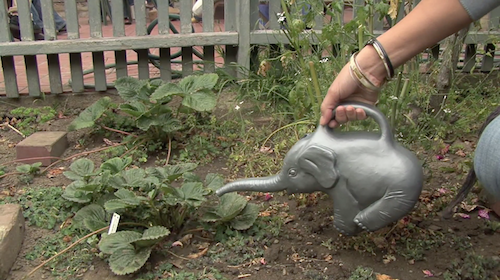
activities, both individually and communally. We focused on Tiffany’s
individual ritual of watering her plants and studying and on Nick’s
individual guitar practice and application to grad schools. We also filmed
them participating in the communal work period they have every Saturday
morning in which the community cleans the entire house, cooking together
for the whole community of 30, and practicing daily bowing, chanting,
and meditation.
In this way, our coverage of the Zen Center closely resembles the focus
of the David and Judith MacDougalls’ Doon School Chronicles(22),
which shows both the communal and individual aspects of a boarding school
in northern India. This film explores the institution’s rituals,
discipline, and environment, giving the viewer a complete picture of the
social life of the boys. It also delves into the main subjects’
individual personalities and unique responses to the school’s elements.
Also, in the same manner that the MacDougalls’ concentrated on particular
boys of a certain character and age group, I also selected my subjects
based on their initial reasons for beginning Zen as well as their status
as novice practitioners. As the MacDougalls’ chose not to emphasize
the roles of teachers and faculty, so, too, does my project disregard
the roles and testimonies of the more advanced level practitioners and
those holding positions of authority at the Center. By focusing on the
novice practitioners, whose lives are still immersed in American routines,
I attempt to fulfill the purpose of my film, which is to introduce students
studying Buddhism academically to American Zen in practice.
To look at it another way, relying on words to tell the story defeats
the purpose of using the medium of film. Coming from an academic background
and being used to educational television documentaries filled with verbal
and textual information, it was very hard but necessary for me to let
go of my attachment to all of the information that my subjects were giving
me. I had to learn that a picture is really worth a thousand words. As
much as my subjects described the experience of practice, simply showing
the viewer what they were talking about eliminates the need to include
lengthy descriptions. I therefore learned the importance of balancing
the emphasis on words with visuals. After all, the essence of Son is beyond
concepts: “Even the 80,000 texts cannot contain or make a record
of it. No scholar can describe it, the intellectuals cannot know it, the
literati and writers cannot recognize it. Even to talk about it is a mistake,
to think about it is an error.”(23)
By giving equal weight to the words and visuals of my film, I capture
the essence of Chinul’s agenda: a balance between intellection and
experience.
>>back to top
The Koan: The Limits of Words:
One element that Chinul introduced to Korean Son practice, which called
attention to the limits of words and concepts, was the hwada,
or kongan(24). A
kongan, translated as “critical phrase” or “the point
beyond which speech exhausts itself,”(25)
involves a question posed to a student by a Zen Master during what is
called a kongan interview. After this meeting between the student and
Zen Master, the student meditates on this phrase, keeping it as a point
of focus during sitting practice until the answer reveals itself to the
student. It is not unusual for a student to spend years on the same kongan
before the answer finally comes. These kongans, which are phrased almost
like riddles and have answers that are not readily accessible by conventional
perspectives, cause the student to contemplate the meaning of the words,
grapple with the conceptual issues of the phrase, and finally realize
that the words are just words and that what lies beneath them is the immediate
present moment in which words and no-words are empty of inherent meaning.
This practice
is the Son shortcut to experiencing the ideal meditative state because
it clears the mind of all its “conceptualizing activities, [leaving]
it clear, attentive, and calm.”(26)
According to Zen Master Seung Sahn, “Names and forms are made by
your thinking. If you are not thinking and have no attachment to name
and form, then all substance is one. Your don’t-know mind cuts off
all thinking.”(27)
However, he warns that having the mindset of nonattachment is also a form
of thinking: “‘I am not attached’ is the same as ‘I
am attached.’”(28)
Therefore, the kongan practice is ultimately about letting go of attachments
to ideas and concepts so that there are no distinctions between attachment
and denial of attachment, leading to the ultimate don’t-know mind.
To incorporate this important practice into my film, I decided to choose
a kongan, or koan, that has been popular in the Zen tradition for centuries
to encompass the entirety of the film. I first heard this koan through
Zen Master Bon Haeng (Mark Houghton) in a preliminary interview when I
asked him whether or not he feels that his practice has become easier
over the years due to his level of experience. He told me that there once
was a family of Zen practitioners. When the father was asked whether his
practice was easy or difficult, he said that it was the hardest thing
in the world. When the mother was asked the same question, she said that
it was the easiest thing in the world. Upon hearing this same question,
the daughter replied, “It’s not easy or difficult. When I’m
hungry, I eat. When I’m tired, I sleep.”(29)
After learning about my subjects’ lives and the way they strive
to maintain their individual activities with their communal practice,
I decided that this koan represented the Son school’s concept of
balance perfectly. I used the three parts of this koan as chapter headings
throughout the film to provide a structure for the viewer. Also, since
the film’s sequences are kept in chronological order according to
the way the events unfolded in the course of filming, the koan represents
the gradual process of realization that I went through as my relationships
with my subjects developed and deepened. In this way, I present the viewer
with an honest account of the filmmaking experience and keep the integrity
of the film as well as of the subjects.
Unlike One Precept, I did not overlay the subjects´ verbal testimony
over the practice footage because I wanted to draw attention to the fact
that these two aspects are combined, but different, methods in Son practice.
For example, there is no talking taking place between the subjects and
myself during bowing, chanting or sitting communal practices. In this
respect, the portions of the film with the practice footage resemble the
fly-on-the-wall approach of One Precept. It also is an effective way of
giving the viewer a sense of being aware of the present moment and the
lack of thought that these practices are supposed to induce, as compared
to the rest of the film in which the viewer is required to digest and
interpret the information given.
Nevertheless, the viewer must be given some kind of context for the reason
and effect of each practice, and such information is given during the
conversations that I have with my subjects during their individual and
communal activities. This is in keeping with Chinul’s contention
that “most people [require] initially the help of scriptural instruction
[even though] they should not engage themselves in its intellectual analysis
for enlightenment.”(30)
Through my conversations with my subjects and seeing what they do in their
personal lives, apart from communal activities, the viewer will be able
to relate to the subjects, understand how the Son practice can be integrated
into Western lifestyles, and decide for themselves, without any authoritative
narration, how psychologically or spiritually beneficial the Son practice
actually is.
>>back to top
Letting
Go of Concepts and Control:
The one effective quality in One Precept, which runs in opposition
to the rest of the film, comes at the beginning during the introductory
intertitle, or textual narration:
| To tell the story of Zen is a paradox, for it is said “Those
who know do not speak…No words, no book, no film, only practice.
Yet Zen is not silence…It has a story. This film is part of
that story. It is a glimpse at those who practice, nothing more. It
is an incomplete statement, an unfinished work…It is a document
of a process, biased through the eyes of those who made it.(31) |
The focus of the film is explicitly stated as the Zen practice, which
comes through in its emphasis on process footage of the practice. Though
the words spoken over the practice are rather ineffective, and there is
no real story arc or climax because the film is only “part of the
story,” the introduction sets the stage for a “glimpse”
into the subjects’ practice, demonstrating “the search for
rather than the achievement of the goals of today’s spirituality.”(32)
However, since the filmmakers’ presence is not felt throughout the
film, the viewer does not feel as though they are taking part in the spiritual
journey for truth. All of the answers are laid out on the table for the
viewer; there is no asking. In contrast to this technique, my film takes
the viewer along my quest of reconciling Eastern practice with Western
lifestyle through a chronological presentation of the events that occurred
during the shooting phase, in the same way that I experienced it.
One Precept´s introductory intertitle announces that it
is simply looking into the world of the temple, capturing only a fragment
of the Zen story. Such reflexivity calls attention to the fact that the
film is an artifact of the filmmakers’ interpretation of the story
as it was presented to them at the time of filming and as it was formulated
in the process of editing.
It also points to the reality that a documentary is not an objective “document,”
an account of the subjects’ lives removed from their relationship
with the filmmaker. The filmmaker’s very presence in their lives
means that the way they would normally experience their daily activities
is not the same as when they experience it while another person watches
and films them doing it. According to MacDougall, “Filming…produces
an object in which the filmmaker’s interaction with the film subject
is explicitly inscribed. Rather than simply running their course, their
experiences intersect permanently in the fabric of the film.”(33)
In fact, he goes so far as to claim that the “subject is part of
the filmmaker, the filmmaker part of the subject.”(34)
This interdependent relationship between filmmaker and subject is representative
of the Buddhist doctrine of emptiness, in which everything is devoid of
an intrinsic nature: The filmmaker is not a filmmaker without the subject
nor vice versa, in the same way that a film does not exist apart from
the interactions between the filmmaker and the subject.
Through the course of my engagement with these subjects, I seemed to have
come full circle: When I first got to know them, I was fascinated by their
practices, which was the reason for my decision to make a film about them;
after researching about their practices, I formulated my own structure
for the way their story would be told based on their psychological and
stress-related reasons for beginning practice, and denied them the opportunity
to control the film; in the end, I learned to let go of my control and
was once again in awe of the way they practice, given their hectic Western
lifestyles. This same three-part movement is described in ancient Zen
philosophy:
| To the man who knows nothing, mountains are mountains, waters are
waters, and trees are trees. But when he has studied and knows a little,
mountains are no longer mountains, water is no longer water, and trees
are no longer trees. But when he has thoroughly understood, mountains
are once again mountains, waters are waters, and trees are trees.(35) |
Through the process of filmmaking, I underwent such a transformation
and had an experience similar to the kong-an practice of letting go of
my attachment to my idea of what the film should be about.
>>back to top
(1) MacDougall. 67.
(2) Ibid. 43.
(3) Ibid. 68.
(4) Ibid. 70.
(5) MacDougall. 4.
(6) Plantinga, Carl R. Rhetoric
and Representation in Nonfiction Film. New York, NY: Cambridge University
Press, 1997. 139.
(7) Grimshaw. 82.
(8)According to Barnouw, “The
direct cinema artist aspired to invisibility; the Rouch cinéma
vérité artist was often an avowed participant. The direct
cinema artist played the role of uninvolved bystander; the cinéma
vérité artist espoused that of provocateur.” Barnouw.
255.
(9) MacDougall. 118.
(10) Feld. 238.
(11) More on this point later.
(12) Grimshaw. 115.
(13) MacDougall. 48-49.
(14) Ibid. 117.
(15) To Live with Herds:
A Dry Season Among the Jie. David MacDougall. University of California
Extension Center of Media and Learning, 1971.
(16) Safizadeh, Fereydoun.
“David and Judith MacDougall Introduction.” Lecture. Boston
University. Boston. 28 March 2005.
(17)Grimshaw. 53.
(18) One Precept: Zen
Buddhism in America. Steve Flood and Robin Adams. Documentary Educational
Resources, 1995.
(19) “One Precept: Zen
Buddhism in America.” Documentary Educational Resources.
20 April 2005 <http://www.der.org/films/one-precept.html>.
(20) A comprehensive explanation
of these will be given later.
(21) Begging is a Japanese
tradition that the subjects are continuing in the states, though the film
made it seem an easier, less time-consuming and patient process than it
must be, considering not everyone in America is a Buddhist devotee as
they are in the Eastern communities surrounding monasteries.
(22) The Doon School Chronicles.
David and Judith MacDougall. David MacDougall, 2000.
(23) “Korean Zen (Son).”
(24) Koan in Japanese.
Encyclopedia of Religion. Second Edition. 1172.
(25) Buswell. 68.
(26) Ibid.
(27) Sahn. 3.
(28) Ibid. 65.
(29) This is a much abbreviated
and paraphrased version of the actual koan.
(30) Moon. 60.
(31) One Precept: Zen
Buddhism in America.
(32) Verbeek, Marjeet. “Too
Beautiful to Be Untrue: Toward a Theology of Film Aesthetics.” New
Image of Religious Film. Ed. John R. May. Kansas City, MO: Sheed
& Ward, 1997. 166.
(33) MacDougall. 56.
(34) Ibid. 29.
(35) Wagner, Robert W. “Film,
Reality, and Religion.” Celluloid and Symbols. Ed. John
C. Cooper and Carl Skrade. Philadelphia, PE: Fortress Press, 1970. 127.
>>back to top
|